

Comparing Chords
50,000' views

One way to gain perspective on a topic is to compare its members to one another. Did you know, for instance, that an augmented chord isn’t the only triad with a #5? Major and minor chords also have a sharp fifth when in their first and second inversions, respectively. I didn’t know this (or think about it) until I had an opportunity to see everything in one view.
In my mission to help understanding, intuition, and maybe even just memorization of all things music, I’ve put together a tool that helps you do the same. Here’s what it can do today, and I’ll discuss my (current) future plans for this:
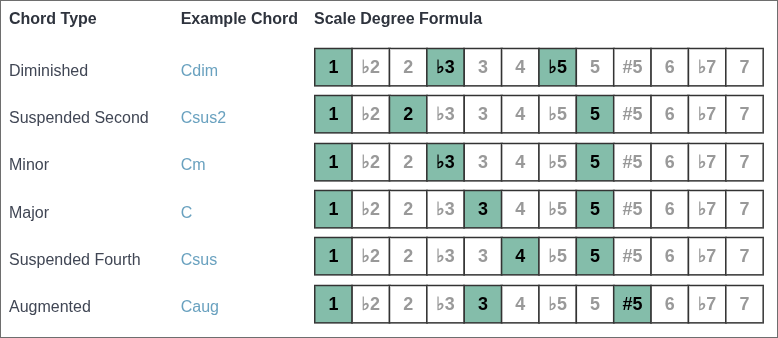
I first take a starting root note and number of notes to restrict this view to, then I output a table that looks something like this containing our note type, some example with the given root, the scale degree formula1 - audio can also be heard for each of these by clicking on the formula. The scale degree formula is useful here, because it helps us to abstract away the specifics of which root we are starting with and compare from a pure shape perspective.
There’s not much more to say about this particular picture, beyond the nice progression you get for the second note from the sus2 through the sus4. Noticing patterns like this helps me to remember things. From here, we also include inversions to fill the picture in even more:
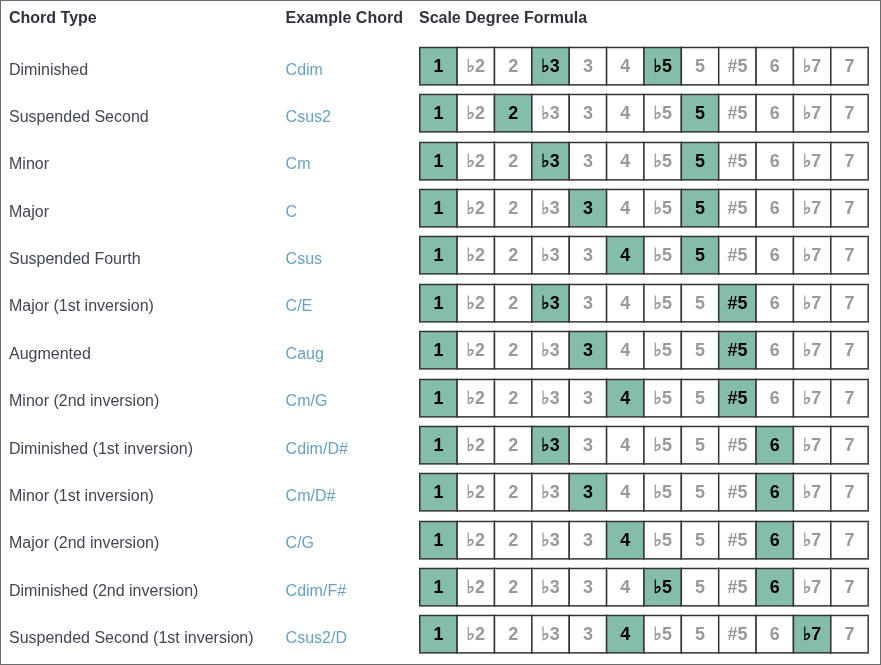
Now we can start to see even more patterns, including the two other triads with the #5. Sometimes trying to visualize something with many dimensions like this can be difficult, but simple things like sorting in different ways can help you see what’s significant. In this case, I’m sorting from the highest note first, and working my way back - this gives us these nice stair-step patterns and helps you more easily understand how many of these chords are a single half-step movement away.
The final thing I’ll point out is how this helps you to understand chord naming better, which always mystified me.
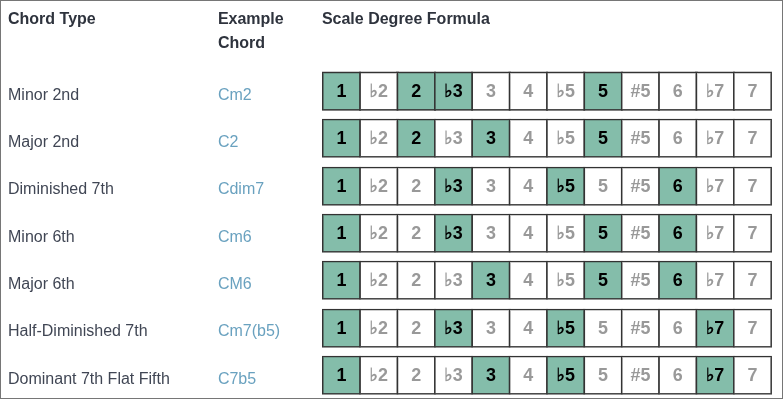
If we set the number of notes to 4, we can begin to see things like these 2’s, 6’s, and 7’s. Many times the name is referencing this scale degree formula2, and while naming isn’t super systematic - it seems to have evolved over time - the more you look at this, you can start to learn the rules.
The 2s and 6s here are pretty obvious - they include the 2nd and 6th scale degrees (respectively), but the diminished 7 seems to violate this, as it has a 6, but no 7.. but then look at the half-diminished 7 to see.. maybe the ‘diminished’ here is applying to the 7 and ‘flatting’ it once more from it’s typical flat-7 scale degree.
I won’t dig further into that for now; just try this for yourself and see what you discover.
Where do I go from here?
I’d like to give a couple of different perspectives on beyond scale-degree, perhaps the actual notes, maybe the interval stack, or even just different ways to sort the chords. I’m also trying to find a way to display all (or at least some) of the unnamed chords in between these listed — the issue here is that there are many combinations that have no names, so it gets a bit unwieldy — it seems there must be something interesting in that uncharted territory.
There’s probably something in here as well about visualizing dissonance and other audible qualities of the chords, though my ideas there aren’t as well formed. In any case, give this a shot, stay tuned for more as I develop things further, and let me know if you have any ideas that can help others in their journey of musical understanding.
If you’re not familiar with the scale-degree formula, it’s just a way to discuss chord construction from some starting note. The numbers represent the ordinal positions of the notes in the major scale for that starting note… since all of these chords start with a ‘C’, or scale will be ‘C Major’ and our positions 1, 2, 3, 4, etc will be C, D, E, F, etc.
This only works for chords that aren’t inversions as I’m choosing to show the scale-degree formula for inversions starting from their lowest note, which isn’t the same as their proper root (in these screenshots, the root is always ‘C’, but the lowest note isn’t for inversions).